A lot of problems in accounting firms can't be magically solved by AI. In fact, the hardest problems are only solved with hard conversations and the courage to change.
 For tech-forward people, sometimes every problem looks like a nail and tech is the hammer. But that's not true in an accounting firm.
We've seen many firms who suffer not from a lack of automation but from doing work they shouldn’t be doing in the first place. Maybe they took on a few too many clients outside their ideal client profile. Maybe they priced too low. Maybe they never trusted others enough to hire out work. Maybe their service offerings are too broad and every project gets out of scope.
There are lots of problems in accounting firms that aren't magically solved by AI. In fact, the hardest problems are only solved with hard conversations, long hours, and courage to change.
Follow the Flow
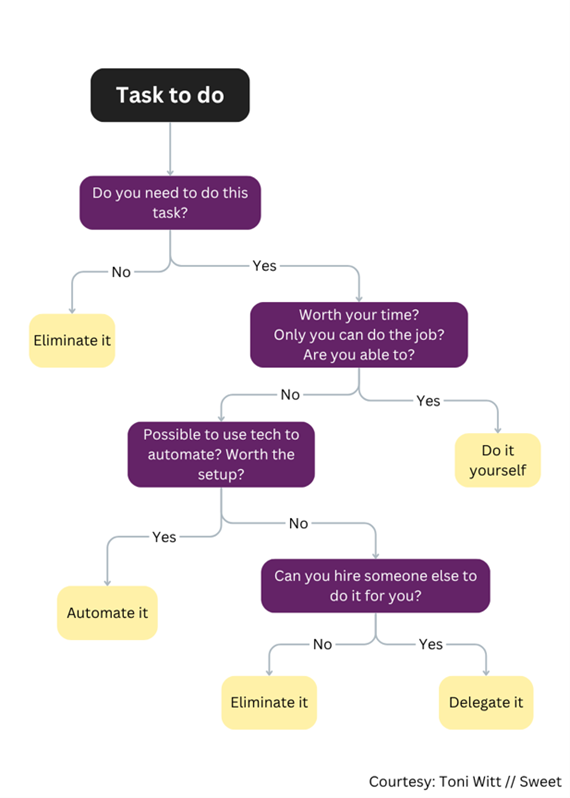
When looking at the work you and your firm do day-to-day, pause and ask: Should I eliminate this task? Delegate it? Or automate it? This is one of my favorite frameworks for running my own business and when talking with firm owners.
Automation should not always be your first choice. In reality, you can’t automate a bad business model. Below is a flowchart of how your decision framework should operate:
When to Eliminate
Elimination should always be your first consideration. Time is too valuable to spend on tasks that don't truly need doing.
Here are common things many successful tax teams end up cutting:
- Clients who are more trouble than they’re worth.
- Out-of-scope work clients refuse to pay for.
- Work that falls outside your core expertise.
- Late-submitted tax documents (just extend them).
- Tasks that drain your energy or patience.
- Collecting duplicate information.
- Responding to excessive client emails or unreasonable requests.
- Taking calls when a quick email would suffice.
- Processes you inherited but can’t explain (“It’s just always been done this way”).
One of the top pieces of advice I hear from seasoned practice owners is to tighten boundaries and refine your services early.
In the beginning, you might need to say yes to everything. But as you grow, focus your scope and let go of problem clients. Eliminating what doesn’t serve you is the simplest, most effective way to free up time for higher-value work, more clients, or more space for your life outside the business.

When to Delegate
In the age of AI, delegation is best suited for tasks that require serious thought, care, and taste, or when AI can't do the job yet.
For example, AI can help you write a report, email a client, and enter them into your CRM for onboarding. But if that client has a tricky or unique situation, and you want to call them to figure out what pricing works for them, delegating that effort makes sense.
Delegation is also great for one-off tasks that don’t happen often enough to be worth truly automating.
This could mean handing it off to your team, hiring a virtual assistant (VA), working with contractors, or even recruiting help from friends or peers.
Delegating actually looks a lot like giving work to an AI agent: you need to give maximum context and clarity on your objective. If a smart person understands the goal, the background, and how you think about the task, they can take ownership.
AI doesn’t replace great humans. Invest in hiring great people and show them how you make decisions. Give them space to step up. You build a strong practice with your team, not just around them.
When to Automate
If a task still needs doing, but doesn’t require your direct involvement, automation might be the way forward. The best tasks to automate tend to be:
- High-frequency.
- Costly or time-consuming when done manually.
- Repetitive and consistent.
- Low in emotional or creative complexity.
Start with the easy wins: automating engagement letter signatures, payment collection, status updates for client returns, or reminding clients of missing docs.
When to Do It Yourself
Doing it yourself should be the last option.
It’s not about being lazy, but rather it’s about understanding your role. As the leader of the practice, your growth is capped by how you spend your time.
The most successful practice owners slowly remove themselves from the day-to-day so they can work on the business and not in it.
That means focusing your energy on high-leverage, asymmetric work where one hour of effort can lead to big returns.
That’s the key difference between employees and business owners. Your job is to steer the whole machine forward by:
- Making key hiring decisions.
- Implementing major tech systems.
- Driving new client acquisition strategies.
- Ensuring your team is aligned.
- Maintaining culture at your firm.
- Planning for the future – whether it’s scaling, selling, or evolving.
Even though you should be making all those calls, you can use AI to help. Whenever I have important decisions to make, or I'm planning big important strategy, I get AI to pressure-test my thinking. I ask it to find the holes in my argument. Consider other angles. Go deeper.
De-automation Can Be a Superpower
De-automation is one of the most impactful things you can do for your highest-value clients.
People really appreciate things that don’t scale. The options are limitless: writing a handwritten note, check-in calls, sending a box of chocolates, having a face-to-face meeting, or preparing custom deliverables.
As firms increasingly become more advisory focused, with a lot of compliance work automated by AI, your clients will appreciate the white glove touches.
If you would like to learn more from Toni Witt, be sure to attend PICPA’s first-ever Artificial Intelligence Conference on Sept. 21. Toni will speak on a host of issues, including building a strong AI foundation, mastering Claude and modern AI assistants, applying AI across core firm functions, and more. Register today.
Toni Witt is the co-founder and CEO of Sweet. He is the Fractional AI Director for dozens of accounting firms and builds AI systems that help firms win real hours back. He has been building AI tools for accountants for over three years and has trained over 2,000 accountants in AI skills.
Sign up for PICPA's weekly professional and technical updates by completing this form.
Statements of fact and opinion are the author's responsibility alone and do not imply an opinion on the part of the PICPA's officers or members. The information contained herein does not constitute accounting, legal, or professional advice. For actionable advice, you must engage or consult with a qualified professional.