Accounting advisory boards at colleges are positioned to make a meaningful impact in strategic planning, faculty, and curriculum to help narrow the skills gap among entry-level accountants.
 The Association to Advance Collegiate Schools of Business (AACSB) recently put out its 2026 Standards for Accounting Accreditation. Only a few schools in Pennsylvania have their accounting programs accredited in this way, but as I was looking it over I started to consider the hallmarks of a “best in class” college accounting program.
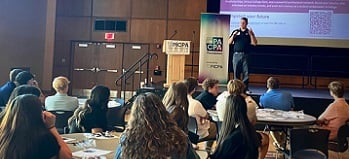
From what I’ve encountered, strong accounting programs often have deep connections to alumni, employers, and the broader profession. The PICPA thinks attention to these three pillars would benefit schools, students, and the profession. So, we’ve begun having discussions with PICPA members who serve on college and university accounting advisory boards through biannual roundtables. In addition to supporting these members with insights and updates to help inform their advisory board conversations, I believe our outreach also helps the PICPA better understand – at scale – the key challenges, opportunities, and trends affecting accounting programs across Pennsylvania. Our next roundtable is July 29 at 1:00 p.m. If you’re interested in taking part in these conversations, please reach out to Amanda Fiel at afiel@picpa.org for more details.
The profession has long understood there is a skills gap among new accountants between meeting graduation requirements and what employers need on a professional’s first day on the job. Alarmingly, that gap now appears to be widening more rapidly. Technological advances are reshaping the work of early-career professionals, and it is evolving at a pace that academia is often challenged to keep up with.
As I reflect on the conversations happening within the PICPA, alongside AACSB’s standards, it’s clear that accounting advisory boards are uniquely positioned to make a meaningful impact on the profession. AACSB’s standards cover nine areas, but I will focus on the three where accounting advisory boards can help narrow the skills gap: strategic planning, faculty, and curriculum.

Strategic Planning
AACSB standards describe an accounting department’s strategic plan as requiring “identity, including the types and levels of accounting degrees offered, the populations it intends to serve, and the types of intellectual contributions it intends to produce to positively impact academia, practice, or policy.” Beyond the number of degrees offered, are colleges and universities focusing in on their degrees’ positioning in the market? As artificial intelligence (AI) democratizes knowledge at a blistering pace, academic accounting programs must articulate a value proposition to students and employers that goes beyond recording debits and credits. A school of business’s accounting degree must solve a problem or create an opportunity. Historical job placement rates or the fact that the degree is required for CPA licensure will not be enough to entice many potential students. If an advisory board is not talking about the accounting program’s value during board meetings, now is the time to get that on the agenda.
Faculty
I pursued a career in accounting because of a wonderful professor who brought theory to life in each class. Countless CPAs have similar stories, and all of us must do what we can to support faculty now. Professors are trying to figure out AI and emerging technologies just like the rest of us. Often, they don’t have the time, resources, and/or incentive structures to prioritize these efforts over myriad other priorities. The result is students are increasingly leaving classes without practical experience in the ways AI and emerging technologies are being used in our profession. Advisory board members need to jump in and help solve this problem. Solutions can range from the simple (talking to a class about what accountants do on a daily basis, including the technologies being used) to the complex (some firms bring educators into the firm to demonstrate how they’re using technology; others provide anonymized client situations as case studies to be used in class). We cannot leave our educators twisting in the wind.
The Pennsylvania CPA Foundation is building a Firm-to-Campus Engagement initiative to help bridge the gap between recent graduates’ skills and first-year firm expectations. This initiative will facilitate structured conversations and collaboration between firms, educators, and students around technical skills, technology proficiency, and early-career readiness. All firms are welcome and encouraged to take part. If your firm would be a good fit, please reach out to the Pennsylvania CPA Foundation at foundation@picpa.org.
Curriculum
The AACSB standards require curricula to align “with professional expectations.” Colleges and universities are the supply chain of talent into our profession, with firms and companies serving as the demand side of that equation. Above all else, advisory boards function best when they make sure the curriculum is relevant to current practice. Certainly, schools and accounting departments face constraints, but through advisory boards the opportunity is there for the profession and academia to work together to identify what can be done to keep the curriculum aligned with professional expectations.
In the AACSB standards, the advancement of accounting as a learned profession is discussed. It states that the “profession operates under a social contract in which it is granted a degree of latitude in managing its affairs in exchange for a commitment to serve” the public interest. Business schools are serious about this, and I am energized by the many outstanding accounting programs I see across Pennsylvania. I look forward to continuing our work to enhance both the supply and demand side of the equation to get ever more talented people into our great profession.
Jennifer Cryder, CPA, is CEO of the Pennsylvania Institute of Certified Public Accountants (PICPA) in Philadelphia. She was named one of the 100 Most Influential People in Accounting by Accounting Today. She can be reached at jcryder@picpa.org.
Sign up for PICPA's weekly professional and technical updates by completing this form.