A firm that hasn’t gone all-in on AI is not automatically behind, and one that has already started off in a sprint isn’t automatically ahead. PICPA’s new Insights report can help firms map out a sound path forward.
 Most conversations about artificial intelligence (AI) in accounting carry an assumption that the firms moving fastest are doing it right and everyone else is falling behind. It can be stress-inducing, for sure. PICPA’s new Insights report, “Start from Trust: Adopting AI and New Technology in Small and Midsize CPA Firms,” takes a different view. Firms can land in the wrong place by rushing just as easily as by stalling.
This Insights report combines a survey of small and midsize firms with a framework for deciding how to engage with AI. Three of the report’s findings are worth bringing to your next partner meeting.
The Three Vulnerabilities Firms See Coming
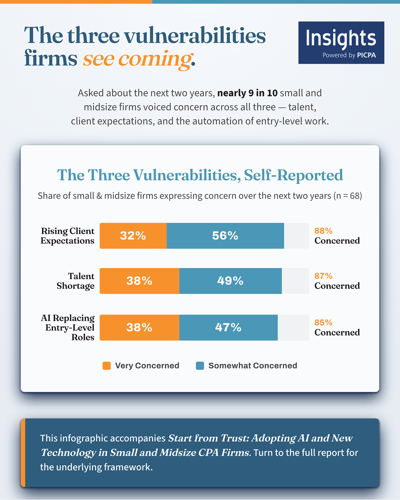 Plenty of firms are performing well right now, and that is exactly what can make this moment in time tricky. Strong demand and healthy margins can hide risks that build slowly beneath the surface. When asked about the next two years, nearly nine in 10 of the small and midsize firms surveyed voiced concern about the same three vulnerabilities: rising client expectations, a tightening talent market, and the automation of the entry-level work that has traditionally trained new professionals.
None of those pressures may show up on this year’s income statement, so they become easy to put off. However, each one builds over time. Clients who get faster, more responsive service somewhere else start expecting it everywhere. Firms that invest in technology become more attractive to the staff everyone is competing for. And once routine work is automated, firms will need another way to teach new hires about judgment that previous work routines used to build.
Two Ways to End Up in the Wrong Place
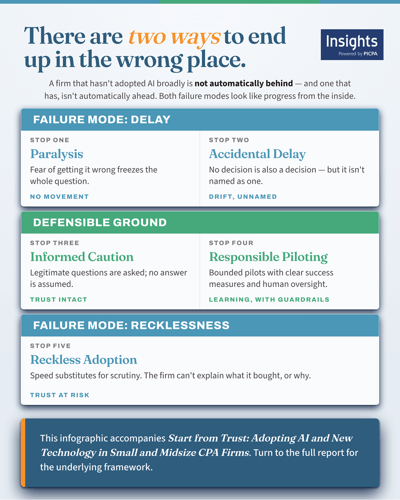 Knowing where the pressures are coming from is one thing. Deciding what to do about them is quite another. The “Start from Trust: Adopting AI and New Technology in Small and Midsize CPA Firms” report has a five-point spectrum to illustrate where your firm may be. Paralysis sits at one end, where fear of getting it wrong freezes the whole question. Reckless adoption sits at the other, where speed takes the place of scrutiny and no one can explain what the firm bought or why. There is also a trap in between called accidental delay, because making no decision is still a decision.
The healthier ground is in the middle, and it is wider than people tend to think. Informed caution means the hard questions are getting asked and addressed. Responsible piloting means the firm is running bounded tests with clear success measures and real human oversight. Neither one requires pretending the risks are not there. If your firm has been holding back, it is worth asking whether that is due to informed caution or a delay from a lack of decisions or conversations being dropped.
What to Ask Any AI Vendor Before You Sign
 For firms ready to look at specific tools, the most useful place to start is the vendor conversation. This is where most adoption decisions get made. That being said, it’s worthwhile recognizing that demos constructed by vendors are always built to impress. They rarely show the conditions your practice will run the tool under, which could include messy client data and a reviewer who has to stand behind the output later. Know that a tool can be technically secure yet still be a poor fit for how a firm has to operate. This gap is where many vendor evaluations go wrong.
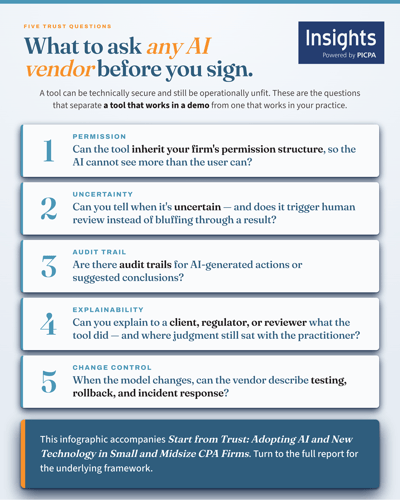
Five questions tend to separate a tool that works in a demo from one that works in practice:
-
Can the tool inherit your firm’s permission structure, so the AI cannot see more than the user can?
-
Can you tell when the tool is uncertain, and does it send those cases to a person instead of bluffing through a result?
-
Are there audit trails for AI-generated actions and suggested conclusions?
-
Can you explain to a client, regulator, or reviewer what the tool did, and where judgment stayed with the practitioner?
-
When the model changes, can the vendor describe its testing, rollback, and incident response?
Asking these in every vendor conversation protects a firm from two common mistakes. One is dismissing a newer product because it is unfamiliar. The other is accepting weak answers because the interface looks polished.
Start from Trust
The report’s all circle back to trust: informed caution keeps trust intact and reckless adoption puts it at risk. That, in the end, is the real stake in these decisions. Clients hire a firm for judgment they can rely on, not for its software. The advice in “Start from Trust: Adopting AI and New Technology in Small and Midsize CPA Firms” is to engage now, while firms still have the ability to do so on their own terms.
The full report explains how to tell where your firm really sits and includes supporting materials such as a vendor evaluation checklist that your team can take into its next meeting.
Sign up for PICPA's weekly professional and technical updates by completing this form.